Remember when a spreadsheet felt like a superpower? You typed in a few numbers, dragged a formula down, and suddenly you had a report. It was fast. It was free. It was enough. But here's the thing about spreadsheets. They grow slower while your business grows faster. And one day, without any warning, they stop helping you and start holding you back.
If you've been feeling like your team spends more time managing tools than managing customers, you're not imagining it. Let's talk about why this happens and how you'll know when it's time for something better.
Why Growing Businesses Still Depend on Spreadsheets
Growing businesses still depend on spreadsheets because they are affordable, familiar, and easy to use in the early stages. However, as teams, customers, and daily operations grow, spreadsheets become difficult to manage. Multiple file versions, manual updates, and disconnected information create delays, errors, and poor collaboration, making it harder for businesses to scale efficiently.
Nobody starts a business planning to run it on spreadsheets forever. It just... happens.
In the beginning, a spreadsheet is perfect. You have three customers, one product, and a small team that sits in the same room. A simple sheet tracks everything you need.
Then you hire your fifth employee. Then your tenth. You add a new product line. Customers start coming from three different cities instead of one. Suddenly, that same spreadsheet is stretched across ten tabs, shared in five different versions over email, and nobody's really sure which one is the "real" one anymore.
This isn't a spreadsheet problem. It's a growth problem. Spreadsheets were built to hold numbers, not to run a living, breathing business with moving parts. And when businesses lean on tools that weren't made for the job, cracks start to show, quietly at first, then all at once.
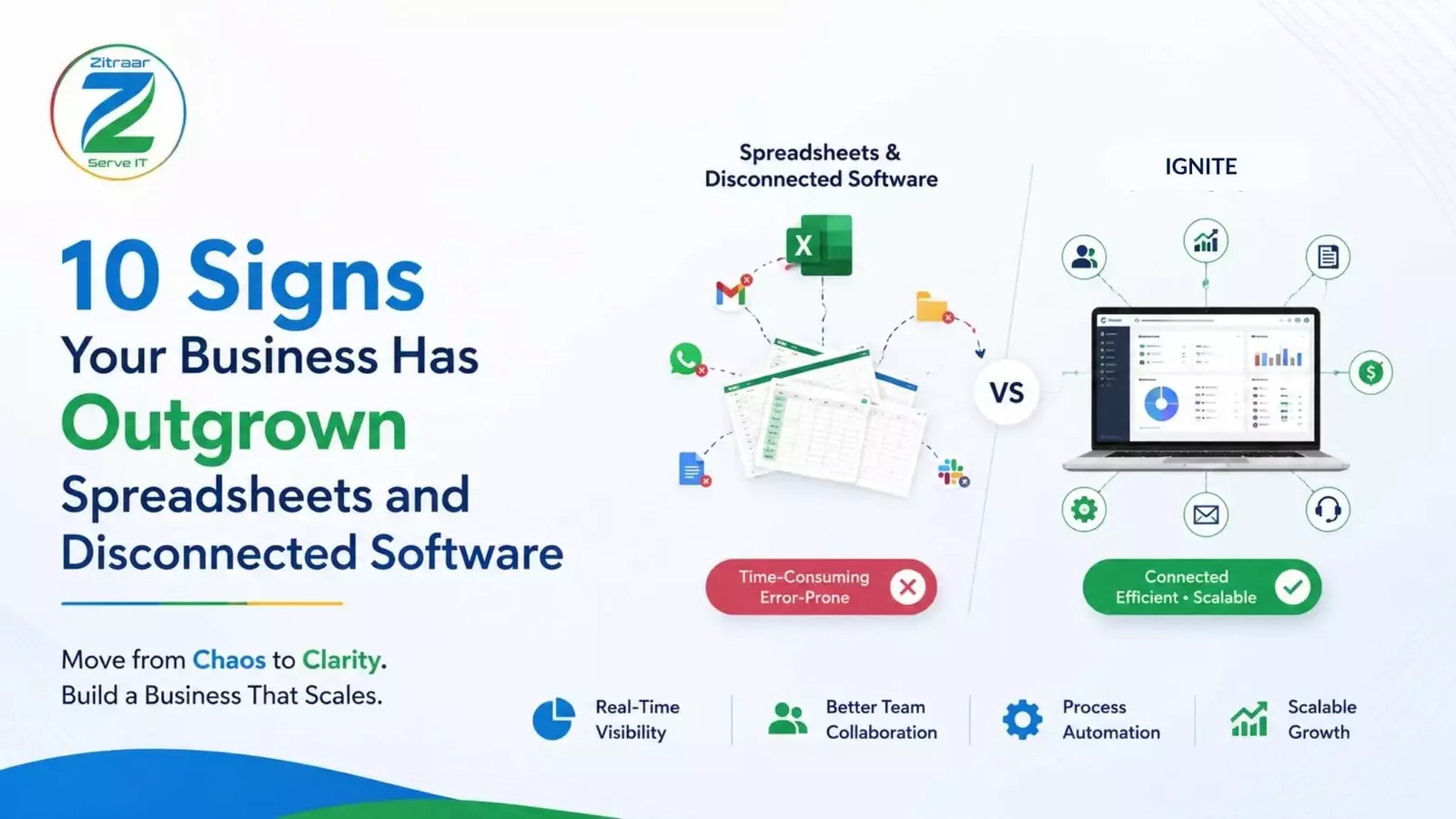
10 Signs You Need a Business Operating System
You may need a Business Operating System if your team enters the same data multiple times, reports don't match, customer information is scattered, approvals take too long, and employees constantly switch between different applications. These signs show that disconnected systems are reducing efficiency and that your business needs a more connected way to manage operations.
So how do you know you've crossed that line? Here are ten signs founders tell us about again and again.
1. Teams keep entering the same data twice. Your sales team adds a customer's details. Then finance adds the same details, separately, into their own sheet. Nobody meant for this to happen. It just does.
2. Reports never match. You ask two team members for the same number, and you get two different answers. Now you're stuck figuring out which one is right, instead of making a decision.
3. Customer information is scattered. A customer's order history lives in one file, their emails live in your inbox, and their support tickets live somewhere else entirely. Nobody has the full picture.
4. Manual approvals slow work down. An invoice needs three sign-offs, and each one happens over WhatsApp or email. What should take minutes takes days.
5. Finance and sales don't share information. Sales closes a deal, but finance doesn't find out until someone remembers to send an email. That gap costs you time and, sometimes, money.
6. Employees switch between too many apps. One tool for chat. One for tasks. One for invoices. One for leads. Your team spends half their day just logging in and out of things.
7. Customer follow-ups get missed. A lead goes quiet for two weeks because nobody remembered to follow up. Nobody's fault, exactly, but it still costs you a sale.
8. There's no real-time dashboard. You can't just glance at your business and know how it's doing today. You have to build a report first, and by the time it's ready, the numbers are already old.
9. Work depends on specific employees. If one person goes on leave, a whole process stops. Because the information lives in their head or on their laptop and nowhere else.
10. Scaling feels difficult, not exciting. Growth should feel like momentum. Instead, it feels like more chaos, more errors, and more late nights just trying to keep up.
Sound familiar? If two or three of these hit close to home, it's worth pausing to think about what's actually holding your business back.
How a Unified Business Operating System Solves These Problems
A unified Business Operating System connects your sales, finance, operations, customer support, and other business functions into one connected workflow. This reduces manual work, improves data accuracy, automates routine tasks, and gives every team access to the same information. As a result, businesses make faster decisions, improve collaboration, and operate more efficiently through business process automation.
Here's the good news. Every single one of those ten signs comes from the same root cause: your business runs on disconnected pieces instead of one connected system.
Growing businesses solve these challenges by improving the way their teams, processes, and information work together. Instead of relying on separate spreadsheets and disconnected tools, they create connected workflows where every department shares the same information. This reduces manual work, improves collaboration, and gives business owners better visibility to make faster decisions.
When a deal closes in sales, finance sees it instantly. No email needed. When a customer raises a support ticket, the right person gets notified automatically. When you want to check how the month is going, you open one dashboard instead of building a report from scratch.
How Zitraar Helps Growing Businesses Connect Their Operations
Zitraar helps growing businesses replace disconnected spreadsheets and software with connected business solutions built on Zoho One. We analyze your existing workflows, identify inefficiencies, and design systems that match the way your business operates. This improves visibility, reduces manual work, supports business process automation, and helps your teams work together more efficiently as your business grows.
At Zitraar, we help growing businesses move beyond spreadsheets and disconnected tools through ourIgnite initiative. We start by understanding how your business works today, identifying bottlenecks, manual tasks, and areas where teams lose time. From there, we design connected workflows and implement the right Zoho One solutions to match your processes. Instead of forcing your business to adapt to new technology, we design solutions around the way your teams already work.
It isn't software you install and figure out on your own. It's a structured, hands-on process. Our team first sits down and maps out how your business actually works today: your sales flow, your approvals, your reporting, and your day-to-day headaches. Then we design and build a system around your real processes, not the other way around. Sales, finance, operations, customer support, and management all begin working from the same connected system. Your team stops re-entering data. Your reports finally match. And you, as the founder, get a real-time view of your business instead of a spreadsheet from last Tuesday.
One of our clients was managing sales, finance, and customer support across spreadsheets and multiple disconnected tools. After connecting their workflows, they eliminated duplicate data entry, reduced reporting time, and gained a single real-time view of their operations.
Conclusion:
Spreadsheets did their job. They got you here. But if you're seeing even a few of the signs above, they've quietly become the thing slowing your business down instead of the thing helping it grow.
The businesses that scale smoothly aren't the ones with the most tools. They're the ones whose tools actually work together. And that shift doesn't need to be complicated, or expensive, or disruptive to your team. Ready to see what that looks like for your business? Book a free consultation with Zitraar and let's map out a system that grows with you, not against you.