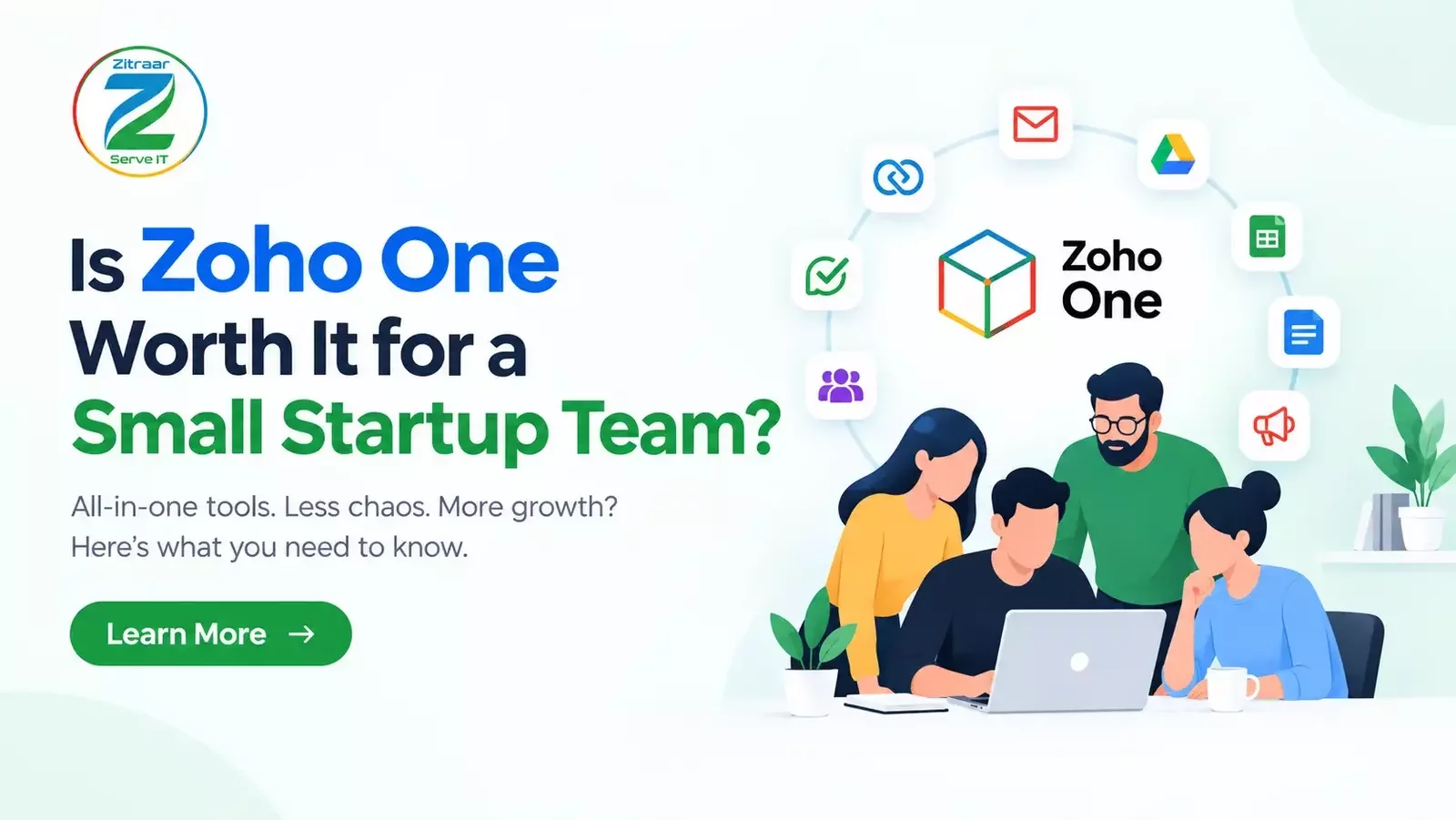
Yes, Zoho One is worth it for most small startup teams in India, especially those already paying for 3 or more separate SaaS tools like a CRM, accounting software, and HR sheet. In 2026, pricing starts around ₹1,250 to ₹1,500 per employee per month (All-Employee plan, plus 18% GST) and includes 45+ business apps covering sales, finance, HR, and support in one login. It works best for teams of 10 to 50 people that invest a little time in proper setup and training. It is less useful for teams under 5 people relying on free tools, or businesses needing one highly specialised app that Zoho does not cover well.
If you are running a startup India, you have likely Googled this question at 1 am while staring at seven different app subscriptions. In this blog, we will break down what Zoho One actually includes, how much it costs for Indian teams in 2026, and whether a lean startup crew of 5 to 20 people really gets its money's worth from it. We will also look at real scenarios so you can decide without the guesswork. By the end, you should have a clear picture instead of another confusing comparison chart.
What Is Zoho One Used For?
Before we get into pricing, let us answer the basic question. What is Zoho One used for? In simple terms, it is a single subscription that provides you with access to more than 45 business apps under one roof: CRM, accounting, HR, projects, helpdesk, email, and even low-code app building. Instead of buying separate tools from five different vendors, paying five different invoices, and dealing with five different logins, everything sits inside one connected system.
For a startup founder juggling sales, finance, and hiring all at once, that single-login convenience is not a small thing. It is often the difference between spending Monday morning fixing broken integrations and actually talking to customers.
What's Actually Inside the Zoho One Bundle
Many founders assume Zoho One is just Zoho CRM with a few extras thrown in. It is not. The suite covers:
Sales and Marketing: CRM, Campaigns, Social, SalesIQ
Finance: Books, Invoice, Expense, Payroll (India supported)
HR and People: People, Recruit, Workerly
Support: Desk, Assist
Productivity: Mail, Docs, Sheet, Show, WorkDrive
Project and Ops: Projects, Sprints, Creator (low-code apps)
If your startup uses even three or four of these individually today, the math starts leaning in Zoho One's favor pretty quickly.
Zoho One Pricing in India, 2026
Here is where most blogs get vague, so let's keep it straight. As of 2026, Zoho One in India is priced roughly like this (excluding 18% GST, billed annually):
All-Employee Plan: Around ₹1,250 to ₹1,500 per employee per month. Every person on your payroll needs a license, even non-tech staff.
Flexible User Plan: Around ₹3,500 per user per month. Only the people actually using Zoho apps need a license.
For a 10-person startup on the All-Employee plan, that works out to roughly ₹1.5 to 1.8 lakh a year before GST. Compare that to paying separately for a CRM, an accounting tool, an HR tool, and email hosting, and most early-stage teams end up saving a decent chunk while gaining dozens of apps they were not even using before.
One thing to keep in mind: the license fee is only part of the cost. Setup, data migration, and configuring workflows properly matter just as much as the subscription price. A poorly set up CRM helps nobody, no matter how cheap it is.
So, Is Zoho One Worth It for a Startup?
This is the real question founders want answered, so let's be direct about it. Is Zoho One worth it for a small team? For most bootstrapped and early-funded startups in India, the honest answer is yes, with a few conditions attached.
It tends to work well when:
You are currently paying for 3 or more separate SaaS tools.
Your team is small enough that per-employee pricing does not spiral out of control.
You want one dashboard for sales, support, and finance instead of switching tabs all day.
You expect to scale headcount and want a system that grows with you instead of one you will outgrow in a year.
It may not be the right fit when:
You need one extremely specialised tool that does one job far better than Zoho's equivalent (some teams still prefer a dedicated ATS or a niche marketing tool).
Your team is under 5 people and your current free-tier tools are genuinely covering your needs.
You are not ready to invest even a little time in proper setup, because an unconfigured Zoho One account is just an expensive folder of unused apps.
If you fall into the first list, Zoho One is very likely worth it. If you're in the second, it is smarter to wait a few months before committing.
A Quick Real-World Example
Take a 15-person D2C startup in Coimbatore. Before Zoho One, they were paying separately for a CRM, Tally for accounting, a basic HR sheet, and Gmail Workspace. Total monthly spend across tools plus a part-time person managing integrations was close to ₹35,000. After moving to Zoho One's All-Employee plan and getting it configured properly, their monthly cost dropped to under ₹25,000, and they stopped losing leads between disconnected spreadsheets. That is the kind of practical shift startups actually notice, not just a feature list on a pricing page.
If you want to see what a genuinely connected setup can look like, explore Zitraar’s Ignite initiative, which looks at how CRM, books, and people can work together without the usual back-and-forth between separate tools.
Things to Sort Out Before You Buy
A few practical tips that save founders a lot of pain later:
Decide between All-Employee and Flexible pricing based on how many non-users you have on payroll.
Map out your current tools and note what data needs to move over.
Do not skip the training step. Zoho has a learning curve, and a team that is not onboarded properly ends up using 10% of what they are paying for.
Verify GST input credit eligibility with your accountant, since it usually applies for business use.
Seek assistance help from someone who has implemented Zoho One before, especially for CRM and Books configuration. It saves weeks of trial and error.
Conclusion
So, is Zoho One worth it for a small startup team? In most cases, yes, particularly if you are already spread across multiple disconnected tools and want one clean system that scales with your headcount instead of fighting it. The pricing is competitive for Indian startups, the app coverage is genuinely broad, and the real savings show up once implementation is done right, not just on the invoice.
That last part, doing the setup right, is usually what separates teams that love Zoho One from teams that regret buying it. If you are weighing this decision for your startup and want a second opinion on whether it fits your specific setup, feel free toget in touch with our team. We can walk you through what a proper Zoho One rollout looks like for a business your size, without the sales pitch.