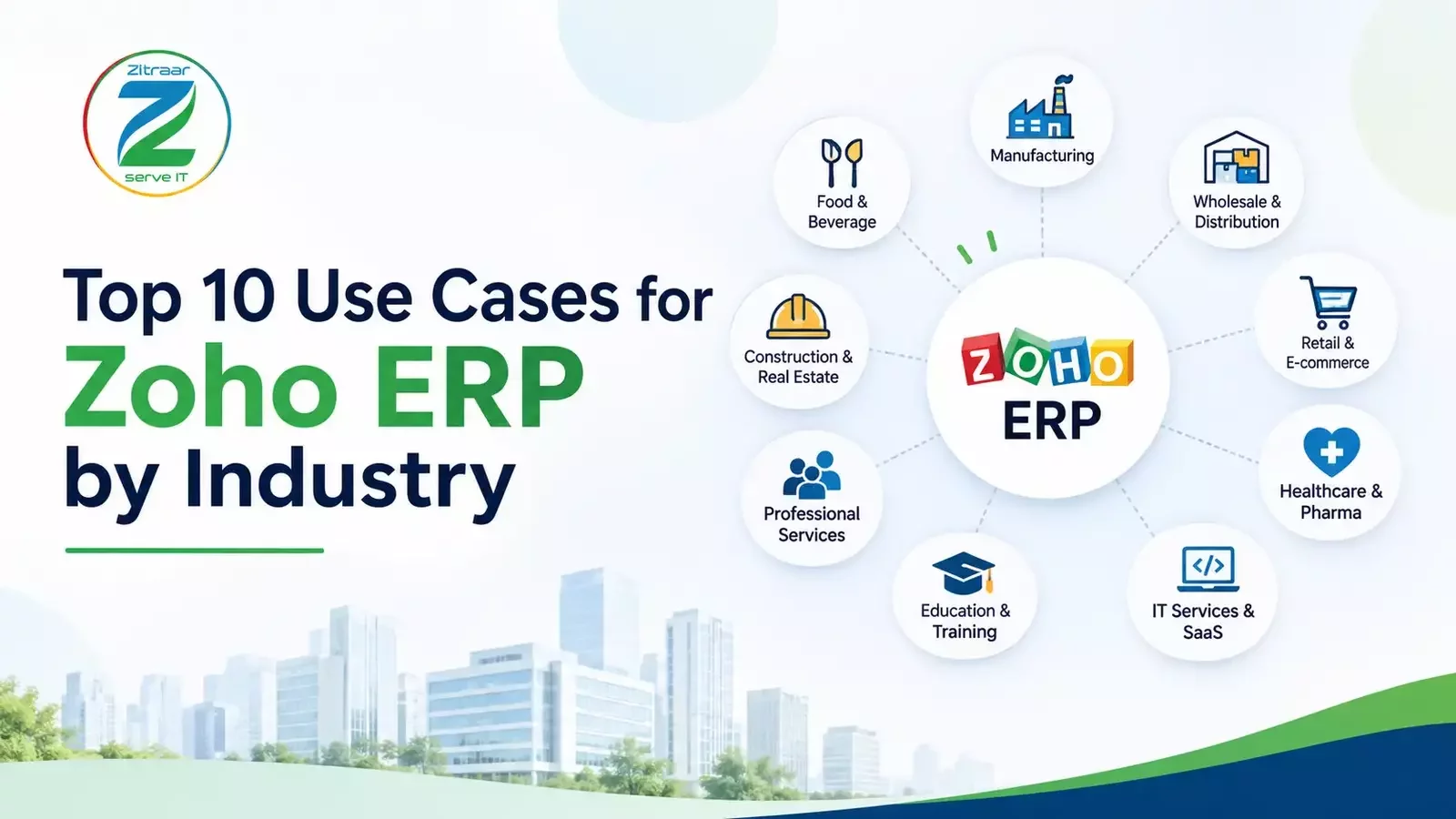
Zoho ERP can help businesses across industries such as manufacturing, wholesale, retail, healthcare, IT services, logistics, education, professional services, construction, and food and beverage manage their core operations more efficiently. Depending on the business requirements and selected Zoho solutions, organisations can connect finance, inventory, sales, purchasing, and operational workflows. Manufacturers may prioritise production planning, distributors may focus on multi-warehouse inventory, while service businesses may need project-based billing and financial reporting.
A successful ERP implementation begins with understanding business processes, identifying gaps, configuring suitable solutions, migrating data, training employees, and providing ongoing support. Zitraar helps businesses evaluate their requirements and plan an ERP implementation suited to their operations.
The use cases for Zoho ERP cover manufacturing, wholesale, retail, healthcare, IT services, logistics, education, professional services, construction and food and beverage. In each, Zoho ERP replaces disconnected spreadsheets and standalone tools with one system for finance, inventory, sales, purchasing and operations.
Zoho ERP is a cloud-based ERP platform from Zoho. It offers industry pages for sectors such as manufacturing and retail, and it works alongside Zoho apps like Books, Inventory, CRM, Creator and Analytics.
Use Cases for Zoho ERP: Industry by Industry
1. Zoho ERP for Manufacturing
Manufacturing businesses often manage production planning, purchasing, inventory, and shop-floor activities through disconnected systems or spreadsheets. Zoho ERP solutions can help bring these processes together, improving visibility into production requirements, material availability, inventory movement, and operational costs. Depending on the selected modules and implementation requirements, businesses can configure production workflows, manufacturing orders, and reporting to support better planning and decision-making.
Planning to connect production, inventory and finance? Talk to Zitraar about your ERP implementation requirements.
2. Wholesale and Distribution
Distributors juggle high SKU counts, multiple warehouses and credit-based customers. Zoho ERP for wholesale and distribution keeps purchase orders, stock levels, sales orders, invoices and payables in sync. Features such as move orders help businesses transfer stock between bins or locations without relying on manual spreadsheet updates.
Managing multiple warehouses or distribution operations? Explore how an ERP implementation could simplify your workflows.
3. Retail and E-commerce
Retailers need consistent stock numbers across physical stores and online channels. Zoho ERP for retail and e-commerce helps manage product categories, inventory, customer records and financial data in one connected system. This reduces overselling, improves stock visibility and minimizes manual reconciliation across sales channels.
4. Healthcare and Pharma
Healthcare organisations, pharmacies, and pharmaceutical distributors require accurate inventory records, purchasing workflows, billing, and financial reporting. Suitable Zoho solutions can help connect these administrative and operational processes. Businesses requiring batch tracking, expiry-date monitoring, or industry-specific compliance workflows should verify the available capabilities and any additional configuration or integrations needed before implementation.
5. IT Services and SaaS
IT service firms and SaaS companies often need project billing, subscription or retainer invoicing, expense control and resource utilization rather than manufacturing modules. Zoho ERP for IT services and SaaS helps connect business deals with project delivery, billing and revenue reporting through integrations with CRM and project management tools.
6. Logistics and Supply Chain
Logistics companies and supply chain businesses need better control over stock movement, vendor performance and delivery costs. Zoho ERP for logistics and supply chain helps organize sales and delivery coverage by region and route while connecting purchasing and inventory information. This gives planners a centralized view of supply chain operations.
7. Education and Training Institutes
Educational institutions manage fee collection, course-wise income, vendor payments and campus assets. Zoho ERP for education and training institutes helps finance teams manage receivables and expenses across multiple branches. Custom applications built with Zoho Creator can also support admissions, student records and batch scheduling when standard modules are insufficient.
8. Professional Services
Consultancies, marketing agencies, accounting firms and legal practices often bill clients by time, milestone or retainer. Zoho ERP for professional services connects proposals, projects, timesheets, invoices and expenses. This helps businesses monitor project costs, track client payments and understand profit margins before the end of each month.
9. Construction and Real Estate
Construction companies, contractors, and property developers need clear visibility into project expenses, purchasing, vendor payments, and financial performance. Zoho ERP solutions, supported by suitable integrations or custom workflows where required, can help organise project-related financial and operational information. This enables businesses to monitor costs more effectively and improve reporting across projects.
10. Food and Beverage
Food manufacturers, restaurants and beverage businesses face challenges such as short shelf lives, recipe-based production and multi-outlet sales. Zoho ERP for food and beverage helps connect ingredient purchasing, production, inventory and sales operations in one system. Businesses should confirm batch tracking, expiry management and other food-specific requirements against their planned Zoho configuration.
How to Choose and Implement Zoho ERP for Your Industry
Choosing the right software is only half the battle. The real value comes from a structured implementation.A successful Zoho ERP rollout follows six essential steps:
1. Map Your Processes and Requirements
Start by writing down how your business operates today. Document how team members manage customer orders, track inventory, handle billing, and route manager approvals. Clear process maps make it much easier to configure the new system correctly.
2. Conduct a Gap Analysis
Compare your daily business needs against standard Zoho ERP features. Identify which requirements work out of the box and which ones need custom features. For complex or industry-specific needs, you can build custom tools using Zoho Creator.
3. Set Up and Configure the System
Build the core foundation of your ERP environment. Set up your chart of accounts, product items, warehouses, and tax rules. Create user accounts, assign roles, and build automated workflows to reduce manual data entry.
4. Migrate Your Data
Clean and transfer your existing business records into Zoho ERP. This step includes moving customers, vendors, item catalogs, and opening financial balances from legacy tools like Tally, Excel sheets, or older ERP systems.
5. Train Your Team and Go Live
Train each department on its specific daily tasks before switching off your old software. Run realistic practice scenarios so employees feel confident using their new workflows before the official cut-over date.
6. Provide Post-Implementation Support
Stay active after the initial launch to ensure smooth adoption. Review financial and operational reports, help users fill adoption gaps, and roll out additional modules in planned phases as your operations mature.
Why Work with Zitraar?
Choosing the right ERP solution is only the beginning. Successful implementation requires a clear understanding of your business processes, operational challenges and long-term goals.
Zitraar helps businesses plan and implement Zoho ERP solutions through requirement analysis, system configuration, data migration, workflow setup, user training and ongoing support.
For manufacturing, FMCG, distribution and retail businesses, the focus is on connecting relevant workflows across inventory, purchasing, sales, finance and operations, based on their specific requirements.
Whether you're moving from spreadsheets, Tally or an existing business system, Zitraar can help you evaluate the right implementation approach.
Not sure which Zoho solution fits your business? Book a consultation with Zitraar to discuss your ERP requirements.