Quick Answer:
Startups often use different tools for sales, finance, marketing, and customer support. While this works in the beginning, it can lead to disconnected data, manual work, and slow decision-making as the business grows. A business operating system brings all key business functions into one connected platform, helping teams work together more efficiently. With business process automation and real-time insights, startups can streamline operations, reduce errors, improve productivity, and build a strong foundation for long-term growth.
Most startups begin the same way. You pick a tool for sales. Another one for finance. One more for customer support. Before you know it, your team is jumping between five different apps just to complete one task.
It feels fine at first. But as you grow, cracks start to show. Data sits in different places. Your sales team doesn't know what the finance team is doing. Reports take hours to prepare. And every time you hire someone new, onboarding becomes a headache because the information is scattered everywhere.
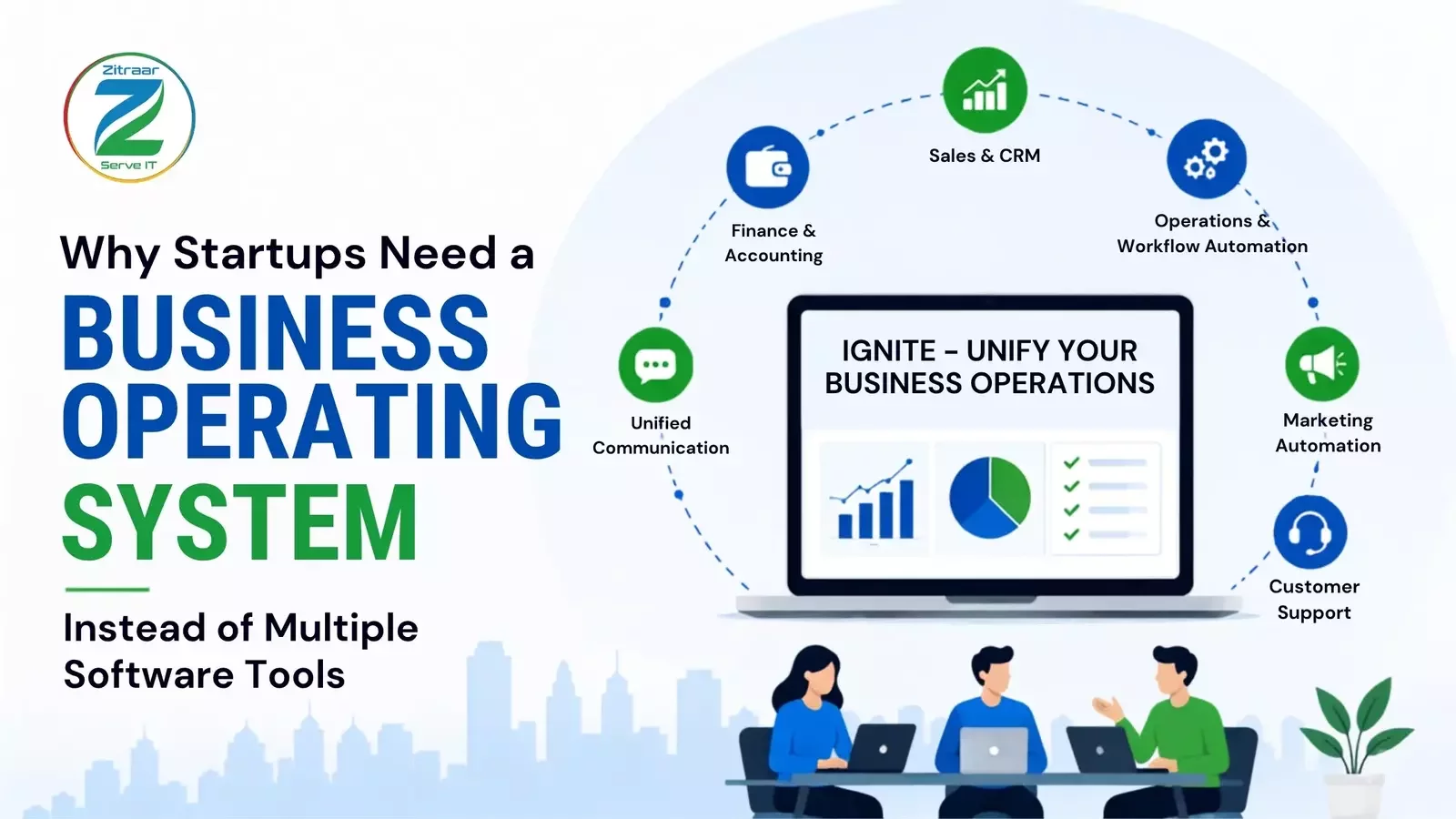
This is exactly the thinking behind Ignite, an initiative by Zitraar designed to help startups and growing SMBs build a fully integrated business operating system through a structured Zoho One implementation. Ignite is not a software or a standalone product. It is Zitraar's initiative that helps startups design, customise, and implement a connected business operating system using Zoho One.
What Is a Business Operating System?
A business operating system is not a single app. It is a connected system that lets every part of your business work together in one place.
Think of it like the operating system on your phone. Your camera, contacts, messages, and apps all live together and share information. You don't need five different phones to do five different things. Everything is in one place, and it works together.
A business operating system works the same way. It connects your
Sales and CRM - track leads, manage follow-ups, monitor your pipeline
Finance and Accounting - handle invoices, expenses, and financial reports
Operations and Workflow Automation – manage approvals, tasks, and internal processes.
Marketing Automation – run campaigns, track responses, and nurture leads
Customer Support – manage tickets, resolve issues, and improve response time
Unified Communication – keep your team connected without endless email threads
When all of these are connected, information flows automatically. Your sales team closes a deal, and the finance team gets notified to raise an invoice. No manual update. No missed step. It just happens.
That is the real power of knowing what a business operating system can do for you.
Why Multiple Software Tools Slow Down Startup Growth
Here is the truth: most startups are not slowed down by a lack of ideas or talent. They are slowed down by disconnected systems.
When your tools don't talk to each other, your people have to do the talking manually. That creates three big problems that we see over and over again at Zitraar when we first speak with early-stage founders.
Problem 1 – Disconnected Software: Your CRM has one set of data. Your accounting software has another. Your operations team works off spreadsheets. Nobody has the full picture, so decisions get made on incomplete information.
Problem 2 - Manual Data Entry: When computer systems do not connect, someone has to copy the data from one place to another. This takes time. It also creates mistakes. A wrong number in a finance report or a missed follow-up with a client can cost real money.
Problem 3 - No Real-Time Reporting: When your data is in five tools, it is hard to get a report. You have to pull data from each tool and combine it. This takes a lot of time. By the time you have the numbers ready, the situation has already changed. You end up making decisions based on old data.
These are not small inefficiencies. For an early-stage startup, they can be the difference between scaling confidently and burning out trying to keep up with your own operations.
How to Streamline Business Operations with One Connected System
Learning how to streamline business operations does not mean doing more. It means doing less, but smarter.
When your business runs on one connected platform, three things happen naturally:
Your team spends less time on admin work. Approvals, task updates, client follow-ups, and report generation happen automatically. Your team focuses on work that actually moves the business forward.
You get a real-time view of your business. One dashboard shows you sales numbers, outstanding invoices, support tickets, and team workload all at once. You stop guessing and start making decisions based on what is actually happening right now.
Your processes become repeatable. When a new client is added, a welcome email goes out automatically. When a deal is closed, an invoice is triggered. When a support ticket is raised, the right person is notified. These are not things your team needs to remember; the system handles them every time, without fail.
This consistency is what lets a small startup operate like a much larger company, without hiring more people to manage the chaos.
What Is Business Process Automation and Why Does It Matter?
Business process automation is simply this: you set up a rule once, and the system follows it every time, automatically.
Here are some real examples of what that looks like for an early-stage startup:
A new lead fills out a form on your website, and it is automatically added to your CRM and assigned to the right salesperson.
A client signs a contract → an invoice is generated and sent without anyone lifting a finger
A support ticket stays unresolved for 24 hours → the system escalates it to a senior team member
A monthly expense report is due → the system compiles the data and sends it to the finance team automatically
These are not complex tasks. But when done manually, they eat hours every week.
At Zitraar, one of our clients, an early-stage service business, reduced its manual workload by 50% simply by replacing its repetitive daily tasks with automated workflows. They did not hire more people. They connected their existing processes into one system and let automation handle the rest. That is what business process automation makes possible.
Choosing the Right Foundation for Long-Term Growth
Here is something many startup founders realise too late: the time to fix your systems is before you scale, not after.
When you hire more people into a broken system, the problems multiply. When you bring new clients into a disconnected process, mistakes become more visible. The right time to build a solid foundation is now, while the business is still small enough to change quickly.
A business operating system gives you that foundation. It is not about using fancy technology. This is about making sure every part of your business is connected. Every process needs to run. The people who work with you, the team members, need to have the information they need to do their job.
This is exactly the thinking behind Ignite, an initiative by Zitraar designed to help startups and growing SMBs build a fully integrated business operating system using Zoho One.
Conclusion:
Ignite is not a software product. It is a structured process. The Zitraar team starts by mapping how your business actually works today, your workflows, your pain points, and your team structure. They make sure Zoho One is set up in a way that works for your business, not just some standard template that does not really fit what you do with Zoho One.
The result is a single connected system that manages sales, finance, operations, marketing, customer support, and communication, all working together, with the right automations in place from day one. If your startup is still running on disconnected tools and manual processes, the foundation you build today will shape how fast and how smoothly you grow tomorrow. Ready to simplify your operations? Talk to our experts and find out how Ignite can help your startup build the right foundation.