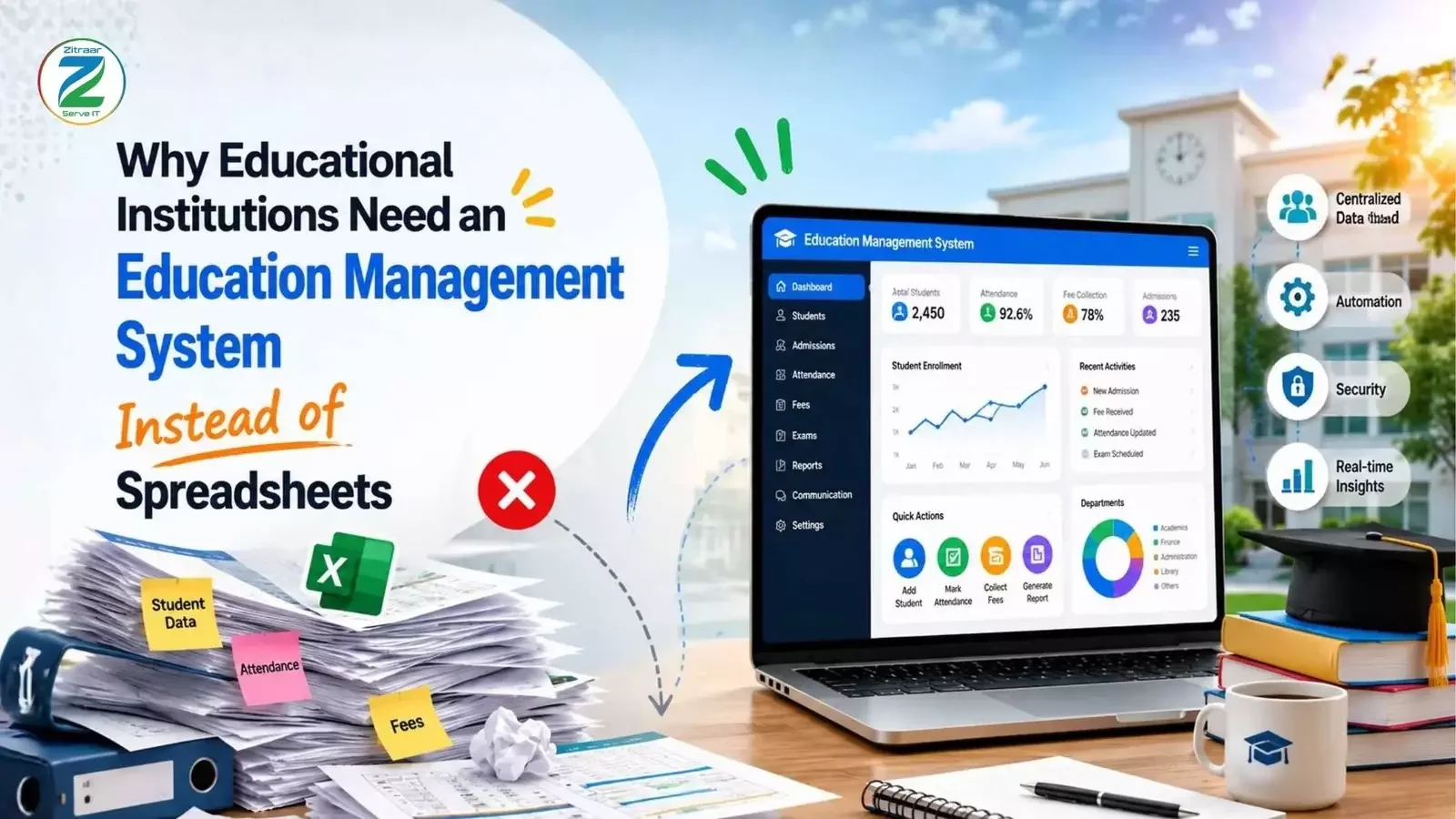
Walk into most schools or colleges today, and you will still find the same scene: staff members juggling multiple spreadsheets to track student records, manage admissions, mark attendance, and prepare reports. It works until it does not.
As institutions grow, so do their administrative demands. More students mean more data. More data means more spreadsheets. And more spreadsheets mean more chances for things to go wrong. What started as a simple file on a computer slowly turned into a tangled web of documents that nobody can fully keep track of.
This is where a structured education management system can make a significant difference.
Through EduFlow, Zitraar’s education-focused initiative, institutions can streamline admissions, academics, attendance, fee management, reporting, and administrative workflows through structured systems aligned with how educational institutions operate.
EduFlow is built on a simple principle: when information, processes, and departments work together seamlessly, institutions can focus less on administration and more on delivering better educational outcomes.
The Growing Challenges of Managing Educational Operations with Spreadsheets
Data Errors and Inconsistencies
When people enter data by hand, mistakes are bound to happen. A student's name might be spelled two different ways across two different files. A fee payment might be recorded in one sheet but not updated in another. Attendance numbers might not match the official report at the end of the term.
These small errors pile up quickly. Over time, they lead to inaccurate reports, confused staff, and frustrated students. For larger institutions with thousands of records, even one small mistake can take hours to track down and fix. Spreadsheets offer no built-in way to prevent duplicate entries or flag missing information, so errors often go unnoticed until they become a bigger problem.
Limited Collaboration Across Departments
In most educational institutions, different departments manage their own separate spreadsheets. The admissions team has one file. The finance office has another. The academic department keeps its own records. Each team works in its own bubble with little visibility into what the others are doing.
This creates information silos and gaps where important data gets lost or never shared. For example, if a student's enrollment status changes, the finance office might not know until much later. Communication gaps like these slow down decisions, delay support for students, and create unnecessary confusion for everyone involved.
Difficulty Scaling Operations
Spreadsheets might work fine for a small institution with a few hundred students. But as enrollment grows, as new programs are added, and as administrative processes become more complex, those files quickly become unmanageable.
Imagine tracking 5,000 student records, multiple departments, and dozens of ongoing processes across a patchwork of shared spreadsheets. It becomes nearly impossible to get a clear picture of what is happening across the institution at any given moment. Spreadsheets simply were not built for that kind of scale.
What Is an Education Management System and How Does It Work?
Centralising Institutional Data
An education management system brings all your institution's data into one place. Student records, academic information, fee details, attendance logs, and administrative documents are all stored on a single, secure platform.
Instead of hunting through multiple files to find what you need, staff can access accurate, up-to-date information instantly. As part of the EduFlow initiative, Zitraar designs and implements customised education management systems using technologies such as Zoho Creator. The objective is to create structured workflows where admissions, academics, finance, administration, and reporting functions work together using accurate and shared information.
This helps institutions improve operational visibility, reduce manual coordination, and maintain consistency across departments.
Automating Everyday Administrative Tasks
One of the biggest advantages of an education management system is automation. Tasks that once took hours, like processing admission forms, tracking attendance, sending fee reminders, generating reports, or routing approvals, can be set up to run automatically.
Through the EduFlow initiative, institutions can implement workflow automation that supports the full student lifecycle, from admissions and enrollment to academics, finance, and alumni engagement. This means staff spend less time on repetitive tasks and more time on work that actually matters.
Improving Accessibility and Visibility
With a proper education management system, the right people can see the right information at the right time. Role-based access means administrators, faculty, and staff each see what is relevant to their responsibilities and nothing more.
Real-time dashboards give decision-makers a clear view of what is happening across the institution without waiting for a manually compiled report. This level of visibility makes it easier to spot issues early, respond quickly, and plan with confidence.
Key Benefits of Using an Education Management System
Modern institutions need technology that supports efficiency, accuracy, and long-term growth. Institutions that adopt an education management system through the EduFlow initiative can experience a wide range of operational and administrative benefits.
Reduced manual administrative work - Staff spend less time entering data and more time supporting students and educators.
Improved data accuracy and consistency - A single system with validation checks means fewer errors and cleaner records.
Faster admission and enrollment processes - Automated workflows speed up application review, approvals, and onboarding.
Better communication between departments - All teams work from shared, live data, reducing silos and miscommunication.
Enhanced student experience and support - When staff have instant access to accurate information, they can respond to student needs faster.
Stronger data security and access control - Role-based permissions ensure sensitive information is only seen by authorised users.
Real-time dashboards and reporting Instant insights replace slow, manual report preparation.
Easier compliance and audit preparation Organised records make it simple to produce accurate documentation when needed.
Seamless integration with payment gateways - Through the EduFlow initiative, Zitraar helps institutions connect their education management system with payment gateways, learning platforms, and other essential tools..
How Educational Institutions Can Successfully Transition from Spreadsheets
Making the switch from spreadsheets to an education management system does not have to be overwhelming. Zitraar follows a structured EduFlow engagement approach to help institutions transition from spreadsheets to connected education management systems in a practical and manageable way.
Evaluate Existing Administrative Processes
Start by taking a clear look at how your institution operates today. Identify tasks that are repeated manually, processes that frequently get delayed, and areas where data is often missing or inconsistent. These pain points are your starting point.
EduFlow begins every engagement by understanding the culture, structure, and constraints of your institution, not just the software side, but the real-world operational challenges your team faces every day.
Define Institutional Requirements
Once you know where the bottlenecks are, it is time to define what your system needs to do. Consider the full student lifecycle from inquiry and admissions to academics, fees, and alumni engagement. Think about which departments need to share data, what reports are required, and which third-party tools need to connect.
EduFlow uses a structured, lifecycle-based approach to requirement collection, making sure nothing important gets overlooked.
Implement and Train Users
Technology is only useful if people know how to use it. A successful transition depends on proper training for all staff members, a phased rollout that minimises disruption, and strong post-go-live support.
Zitraar's team does not just implement software and walk away. They stay involved, provide continuous training, and ensure that your staff feels confident using the system before the next phase begins.
Continuously Optimise and Scale
An education management system is not a one-time setup. As your institution grows and your needs change, the system should grow with you. Through the EduFlow initiative, Zitraar uses technologies such as Zoho Creator to build scalable education management systems that support institutional growth, evolving processes, and changing operational requirements over time.
As institutions expand programs, student populations, and administrative responsibilities, the system can be adapted to support new workflows and operational needs.
New features can be added, workflows can be refined, and integrations can be expanded as your operations evolve. You will always be ready for whatever comes next.
Conclusion
Spreadsheets served their purpose, but they were never designed to support the growing operational demands of modern educational institutions. As institutions expand, managing admissions, academics, attendance, fees, communication, and reporting through disconnected files becomes increasingly difficult.
The goal is not simply to replace spreadsheets. The goal is to create a smoother flow of information, processes, and coordination across the institution. Through EduFlow, Zitraar helps educational institutions implement structured education management systems that bring departments together, improve operational visibility, and support sustainable institutional growth.
By aligning technology with real educational workflows, institutions can spend less time managing administrative complexity and more time focusing on students, educators, and educational outcomes.